Orange Inheritance
If you were asked to recommend one book to a new generation of readers, what would you choose?
To mark the launch of the Orange Inheritance collection, Orange and Vintage Classics asked 100 men and women including authors, celebrities and a range of Orange Prize judges and patrons, to select the book they would choose to pass on to the next generation.
Amongst those who submitted choices were Mark Haddon, Rachel Johnson, Alan Titchmarsh, Emma Freud, Colin Murray, Fiona Phillips, Bear Grylls, Susanna Reid, Irvine Welsh, Michael Morpurgo, Joanne Harris, Jung Chang, Louis de Bernières, Martha Lane Fox and Will Self.
Your chance to win the Orange Inheritance Collection
What would you Inheritance read be? Email your answer to vintagebooks@randomhouse.co.uk - our favourite 6 responses will win a set of the 6 books in the collection and feature on the website. We look forward to reading your choices.
Looking for more inspiration?
The entire list of 100 responses can be downloaded here, a small selection of which can also be seen below.
Louis de Bernieres
 |
'The Bridge on the Drina, by Ivo Andric. It’s a rivetingly interesting book the chronicles the centuries in the life of an Ottoman Bridge in Bosnia. I have never read anything else like it, and it is a miracle that such a bad idea turned out to be such a fabulous book.' |
 |
Deborah Moggach
 |
'I would pass on Arnold Bennett’s “The Old Wives’ Tale” because nobody else will – it’s a scandalously neglected classic. In fact it’s one of the great novels – an ambitious story spanning forty years (from the middle to the end of the 19th century) and exploring such themes as the birth of advertising, the rise of captalism, the siege of Paris, the beginnings of feminism and much more. But basically it’s the story of two sisters, born in a draper’s store in the Potteries, whose lives take two quite different paths. I would recommend it not just because it’s so gripping, but because the writing itself is startlingly bold and original – quite modernist, in fact – and because one is hooked from the first page. Let the next generation discover Bennett and their lives will be richer. This generation seems to have missed him altogether.' |
 |
Ian Mortimer
 |
'I read Boris Pasternak's ‘Doctor Zhivago’ when I was nineteen, on my way to Barcelona. I was so compelled by it that evening as I waited at Victoria Station that I missed my train. The next one was not for another twelve hours. I didn’t care: I simply booked myself into the nearest cheap hotel, and sat on the bed reading it through the night. It made me realise that serious historical fiction can draw attention to the meaning of the past, not just the events themselves, and so it goes beyond the usual parameters of history to connect the living past and usin the present, and perhaps even the future as well. I often reflect on that experience because it is quite a shock for a historian to realise that some aspects of our relationship with the past can only be captured in fiction - that studying historical facts alone is not enough. There are quite a few great books that do this, of course, and I hope that Dr Zhivago would be taken to represent them all, so that people see the importance of understanding humanity over time, not just in the glossy magazine of the present age, and not as something apart from them, cut off by the distancing effect of history.' |
 |
Irvine Welsh
 |
'Naked Lunch - by William Burroughs. It puts hairs on your bollocks. It really did blow literature apart, as the dust jacket says. You couldn't have everyone doing that sort of thing, and its spawned a host of talentless, cringe-inducing imitators, but one highly-original pioneer was absolutely essential.' |
 |
Jung Chang
 |
'George Orwell, Nineteen Eighty-Four. I read it when I first came to Britain in 1978 when I was 26. I marvelled at how aptly Orwell’s description fitted Mao’s China, where I grew up. But I also learned a great deal about the world and human beings in general, knowledge that I feel is essential.' |
 |
Michael Morpurgo
 |
'The Man Who Planted Trees by Jean Giono. It's the story of one man's mission to bring new life to a bleak landscape in Southern France. It's a novella that has an epic quality about it, and of course is even more relevant now than it was when it was written in the first half of the 20th century. The most compelling book I know and maybe the most important. Wish I'd written it myself. Very cross about that.' |
 |
Samantha Harvey
 |
'Mrs Dalloway/Virgina Woolf. Even the imaginary responsibilty of passing a novel to the next generation is great; it would have to be one that reminds readers of why novels have an absolute right to exist, and on that basis I'd choose Virginia Woolf's Mrs Dalloway.
I don't know who could fail to admire this book; Fear no more, says the heart. Fear no more, says the heart, committing its burden to some sea, which sighs collectively for all sorrows, and renews, begins, collects, lets fall. There isn't a more beautifully written book in the English language in my view (though there are some equals), and there isn't a book that uses words so effectively to get past words. To read it is to feel like you're not reading at all, but instead are in direct communion with other minds.' |
 |
Xinran
 |
'Les Miserables could guide a young heart to learn that love is about how much you can forgive and how much you can understand others' |
 |

Orange Inheritance
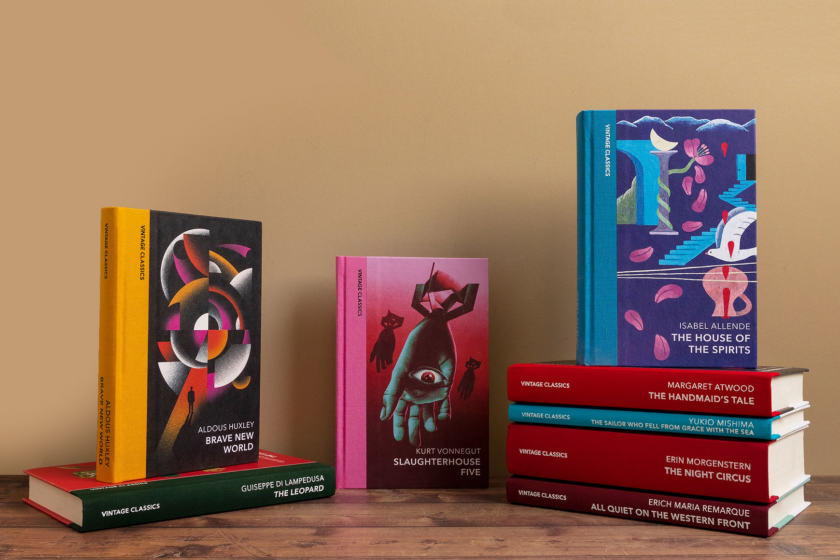
Created to celebrate the 16th anniversary of the Orange Prize for Fiction, six Orange Prize winners have selected the books they would pass onto the next generation. Beautifully designed in the distinctive Vintage Classics style, the six books and eBooks will include introductions from the Orange Prize for Fiction winners explaining why their choice is relevant to the next generation.
Available nationwide from April 7th and available to download on the Orange Book Club at www.orange.co.uk/bookclub. To find out more about the collection click on the jacket images down the side of the page or visit the Orange Prize website here.